

Policy alternatives for livestock development in Mongolia /PALD/
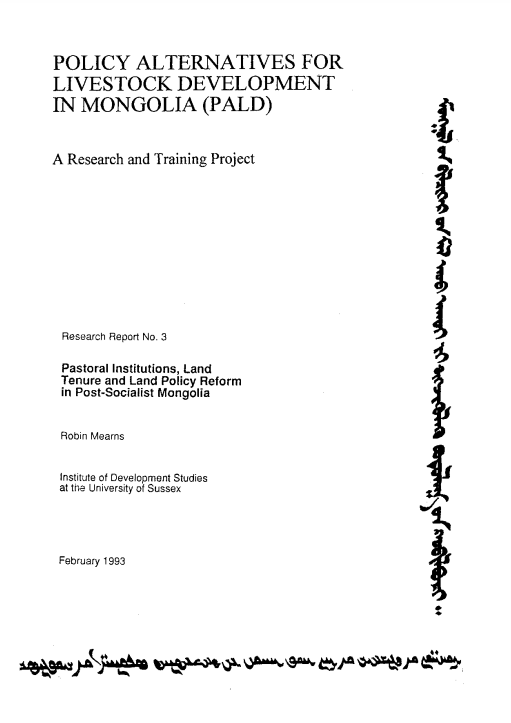
This is a Research and training project. This report is organised as follows. Section 2 explains the methodology used in the fieldwork. Section 3 outlines the evolution of Mongolian pastoral institutions in general, emphasising elements of continuity as well as change between three distirict historical periods. Recent date are included to bring this up to date as far as possible to mid 1992. Section 4 provides an overview of changing pastoral land tenure arrangements over the three historical periods, and their environmental consequences. Sections 5 and 6 respectively detail the results and analysis of data from the two sample sites/ Tariat district of Arkhangai aimag. representing the Gove desertsteppe zone/ on local pastoral pastoral institutions and the contrasting patterns of pastoral mobility and flexibility in response to ecological risk that are found to characterise the two regions.

Mongolian Garment Industry: Likely Effects of Abolition of Quotas and Actions that are Urgently Required
Хэвлэн нийтэлсэн: EPRC, USAID
Он: 2004
Файлын төрөл: pdf
Файл: /uploads/site/1126/res_mat/garment_industry_eng.pdf
Түлхүүр үг: garment industry, international trade, cashmere industry, Mongolian economic competitiveness, trade quotas, textile and clothing industry, textile and clothing product export, Mongolian garment industry
Хэвлэн нийтэлсэн: Human Rights Center, University of Essex
Он: 2005
Файлын төрөл: pdf
Файл: /uploads/site/1126/res_mat/State of Democracy in Mongolia.pdf
Түлхүүр үг: democracy development in Mongolia, state of democracy analysis, Mongolian democratization, Mongolian parliamentary election, Mongolian presidential election, Mongolian political parties, democracy and human rights in Mongolia


Ерөнхийлөгчийн 2005 оны сонгуулийн хэвлэл мэдэээллийн мониторингийн хоёрдахь шатны дүн
Монгол Оросын худалдаан дахь тарифын бус саад тотгор, стандартуудын талаарх судалгааны дүн шинжилгээ