

The Cashmere production of Mongolia is the second largest in the world after China and it has an impact not only on the economy of our country but also to some degree, on the world market. The role of the participants, both women and men, in the cashmere production process is expected to increase with the development of the cashmere sector. UNIFEM’s priority has been to ensure the economic rights of women, and to promote empowerment and the capacity of individual’s to sustain their own livelihood. As a reflection of this priority, a report entitled "Women in Mongolia: Mapping the Progress under Transition" was published in 2000. This report underlined the fact that women’s participation in cashmere production was an indicator of women’s economic participation and that the economic empowerment of women was closely interwoven with cashmere production. Building on this research, the current survey on "Cashmere Value Chain: Participation of Women and Men" has been conducted and is presented in the following pages.

Mongolian Garment Industry: Likely Effects of Abolition of Quotas and Actions that are Urgently Required
Хэвлэн нийтэлсэн: EPRC, USAID
Он: 2004
Файлын төрөл: pdf
Файл: /uploads/site/1126/res_mat/garment_industry_eng.pdf
Түлхүүр үг: garment industry, international trade, cashmere industry, Mongolian economic competitiveness, trade quotas, textile and clothing industry, textile and clothing product export, Mongolian garment industry
Хэвлэн нийтэлсэн: Human Rights Center, University of Essex
Он: 2005
Файлын төрөл: pdf
Файл: /uploads/site/1126/res_mat/State of Democracy in Mongolia.pdf
Түлхүүр үг: democracy development in Mongolia, state of democracy analysis, Mongolian democratization, Mongolian parliamentary election, Mongolian presidential election, Mongolian political parties, democracy and human rights in Mongolia


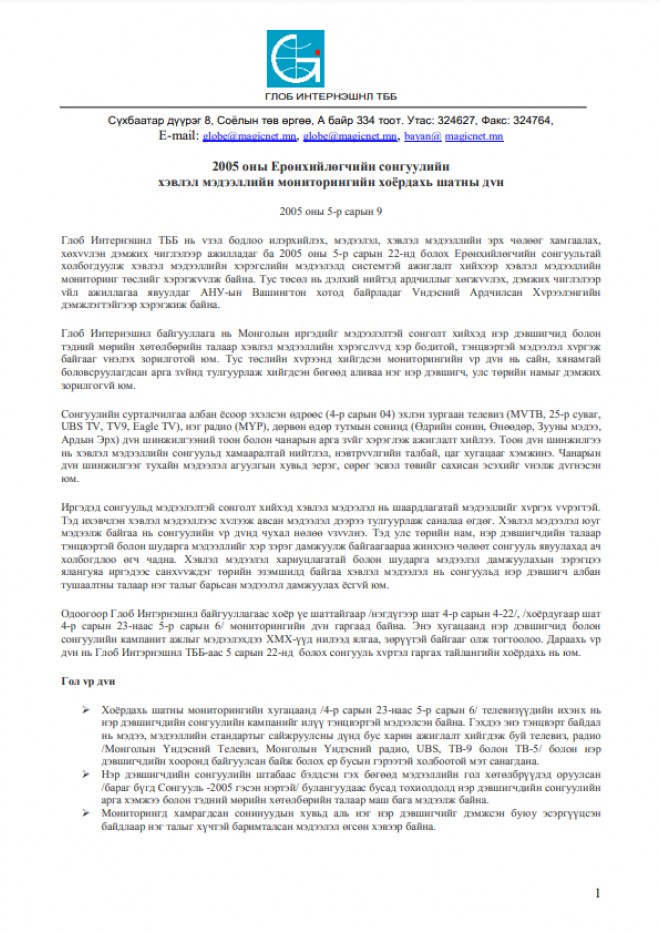
Ерөнхийлөгчийн 2005 оны сонгуулийн хэвлэл мэдэээллийн мониторингийн хоёрдахь шатны дүн
Монгол Оросын худалдаан дахь тарифын бус саад тотгор, стандартуудын талаарх судалгааны дүн шинжилгээ